
 Battle of AtlanticHistorical BattlesU-Boat TacticsU-Boat PersonalitiesMedals & AwardsPhoto GalleryVideo LibraryArticles
 U-Boat Types
 How a U-Boat Works How a U-Boat Works |
|
Type IA |
|
Type II |
|
Type VII |
|
Type IX |
|
Type XIV |
|
Type XXI Elektroboat |
|
Type XXIII |
|
Flak U-Boat |
Midget SubmarinesU-Boat WeaponsU-Boat EquipmentBridge ConversionU-Boat CrewU-Boat InsigniaU-Boat MarchesU-Boat SoundsU-Boat Scale Models Links DirectoryContact UsOur AwardsGuestbook

|

U-Boat Types
| Contents of this chapter | |
| How a U-Boat Works | Type IA |
| Type II | Type VII |
| Type IX | Type XIV |
| Type XXI Elektroboat | Type XXIII |
| Flak U-Boat | |
|
|
|
|
Authored by Uboataces |

|
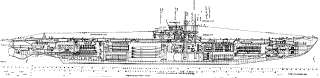
The German Navy was very definite about their requirement of an Atlantic going U-boat. The most important offensive characteristics were surface speed, range, maneuverability and the number of torpedoes carried. Accordingly, since submerging was the primary escape method, dive speed and depth were definite desirable characteristics. With the advancement of technology, particularly in the field of electronic and optical advancement, this had allowed German engineers (and otherwise) to design far more effective U-boats than the U-boats of the First World War era.
The Kriegsmarine understood that given the limited underwater capabilities of the U-boat, it was not to be considered as a true submarine. Rather, a U-boat was principally considered as a torpedo boat, with the special capability to submerge for attack - or as a defensive measure. Thus a U-boat was short for Unterseeboot, or underwater boat.
Between 1919 until the end of the Second World War, Germany designed many U-boats ranging from special purpose tiny midget subs to the giant sea cow (seekuh) supply u-boat. Many were nothing more than designs that never made it past the drawing board.
This section showcases the u-boat types commissioned during World War Two. Please use the navigation buttons on the left to select the U-boat type.
|
|
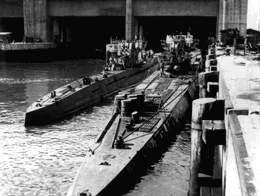
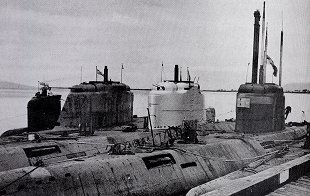
| Type VIIC on the left, next to the much larger Type IXD2 long-range U-boat docked at Trondheim U-bunker, September 1944. The IXD2 could reach distances as far as 23,700 nautical miles. | Donitz had pinned his hopes on the revolutionary Type XXI to restore the balance to the Kriegsmarine. It was a case of too few and too late, but would later influence modern submarine designs. |
