
 Battle of AtlanticHistorical BattlesU-Boat TacticsU-Boat PersonalitiesMedals & AwardsPhoto GalleryVideo LibraryArticles
 U-Boat TypesMidget SubmarinesU-Boat WeaponsU-Boat EquipmentBridge ConversionU-Boat CrewU-Boat InsigniaU-Boat MarchesU-Boat SoundsU-Boat Scale Models
 Links DirectoryContact UsOur AwardsGuestbook

|

U-Boat Bunkers
The origin of the first U-boat bunkers traced back to the period of the First World War, where it was hardly a bunker at all. Along with the submarine, the First World War saw the introduction of yet another dominant weapon in the battlefield – the airplane. Whereas previously, ocean going vessels were threatened only by other vessels, but the introduction of the airplane brought about a new threat from the sky. Not only were airplanes reconnoitering the seas, but they were also looking for among other things, surface ships and submarines to attack. It soon became obvious that ships and submarines berthed in their moorings were sitting ducks and frequently became targets of attack.
The first protective structures for U-boats were not designed to protect against aerial bombs, but rather to conceal the presence of an underlying boat from prying eyes. The first such structure was erected in Brugge (Belgium) where sheet metal measuring 70 meters by 20 meters were laid out overhanging the mooring points. These were later reinforced by wooden beams, planks and earth, which provided little protection except from splinter explosions. Eventually, the coverings were reinforced by concrete and by now these shelters provided adequate protection against light bombs. The first shelter could accommodate five U-boats.
|
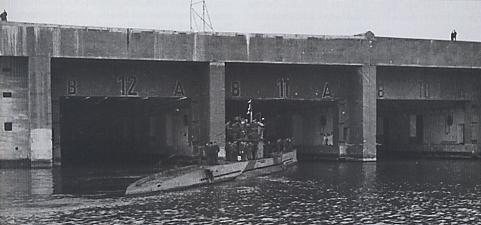
| U-136 sails into its pen in Lorient. Safely berthed inside, these bunkers provided protection from air raids. |
However, these structures were considered makeshift but as the threat from the skies grew in intensity, along with the size of the bombs being dropped, so was the need for a more permanent bomb resistant structure. From the early months of the First World War, the size of the air dropped bomb had grown from a mere 5kg to 700kg towards the end of the conflict. In response to this, the first bomb resistant bunker with concrete roofing was built, also at Brugge. It had eight compartments, with each compartment measuring 62 meters long, 8.8 meters wide and 6 meters tall (internally). These very much resembled the U-boat bunkers of World War Two.
By the opening of the Second World War, plans for proper U-boat bunkers complete with protection for dockyard facilities were already laid out well in advance. The objective was not only to protect the boats from air attacks, but also to enable minor repairs to be carried out without interruption from air raids. However, with the fall of France and the occupation of Norway, new U-boat bases were made available which were much more strategically advantageous due to their proximity to the Atlantic. Construction priorities then shifted from bunkers in Germany to those in the occupied countries.
There were also plans for building complete bunkered shipyards, fully equipped and self-sufficient with dry docks for major repairs and construction, but there were always other more pressing or urgent needs that these never saw fruition. Plans for the construction of bunkers as far away as the Mediterranean and the Black Sea were also conceived, but these too never took place.
|
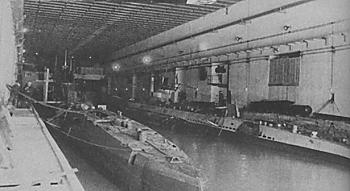
| Two Type VIIs undergo refit in the massive U-boat pens in St. Nazaire, occupied France. |
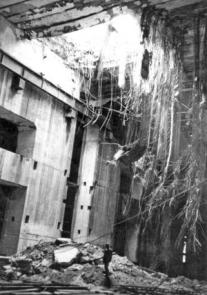
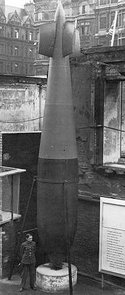
The protection offered by these bunkers were adequate throughout the early years of the war, until 1943 or 1944 when the Allies introduced the Tallboy and Grand Slam bunker buster bombs. These 12,000 and 22,000 lbs bombs scored numerous direct hits and several bunkers were penetrated. The response was to further reinforce these bunkers from between 3 – 7 meters to 7 – 10 meters, but up to the end of the war, these were never completed.
|
|
| A bunker holed by a Grand Slam bunker buster bomb. | Grand Slam bunker buster bomb. The figure provides a good scale of the size of the 12,000 pound bomb. |
U-Boat Bunkers
| U-Boat Bunkers in Germany, 1939 - 1941 | ||||||
| Location | Name | Size (m) | Roof Thickness |
No. of Docks | Capacity | When Constructed |
| Hamburg | Elbe II | 137 x 62 | 3 | 0 dry, 2 wet = 2 | 6 boats | Dec 1940 - 1941 |
| Hamburg | Fink II | 151 x 153 | 3.6 | 0 dry, 5 wet = 5 | 15 boats | Mar 1941 - 1944 |
| Heligoland | Nordsee II | 156 x 88 | 3 | 0 dry, 3 wet = 3 | 9 boats | Jan 1940 - Jun 1943 |
| Kiel | Kilian | 176 x 79 | 4.8 | 0 dry, 2 wet = 2 | 12 boats | Nov 1941 - Nov 1943 |
| Kiel | Konrad | 163 x 35 | 3.5 | 1 dry, 0 wet = 1 | 5 boats | Apr 1943 - Oct 1944 |
| Bremen | Hornisse | 362 x 68 | 4.5 | Mar 1944 (incomplete) | ||
| Bremen | Valentin | 450 x 100 | 7.3 | Feb 1943 (incomplete) | ||
| U-Boat Bunkers in France, 1941 - 1944 | ||||||
| Location | Name | Size (m) | Roof Thickness |
No. of Docks | Capacity | When Constructed |
| Brest | - | 192 x 333 | 6.2 | 10 dry, 5 wet = 15 | 20 boats | Jan 1941 - Jul 1942 |
| Lorient | Dom | 81 x 16 | 1.5 | 2 dry, 0 wet = 2 | 2 boats | Feb 1941 - May 1941 |
| Scorff | 129 x 51 | 3.5 | 0 dry, 2 wet = 2 | 4 boats | Apr 1941 - Aug 1941 | |
| Keroman I | 403 x 146 | 3.5 | 5 dry, 0 wet = 5 | 5 boats | Mar 1941 - Sep 1941 | |
| Keroman II | 403 x 146 | 3.5 | 7 dry, 0 wet = 7 | 7 boats | May 1941 - dec 1941 | |
| Keroman III | 168 x 142 | 7.5 | 5 dry, 2 wet = 7 | 13 boats | Oct 1941 - Jul 1943 | |
| Keroman IVa | 160 x 130 | 7 | 4 dry, 1 wet = 5 | 24 boats | Jul 1943 (incomplete) | |
| Keroman IVb | 95 x 150 | 7 | 3 dry, 0 wet = 3 | (incomplete) | ||
| St. Nazaire | - | 291 x 124 | 7 | 8 dry, 6 wet = 14 | 20 boats | Mar 1941 - Jan 1942 |
| La Pallice | - | 195 x 165 | 7.3 | 7 dry, 3 wet = 10 | 13 boats | Apr 1941 - Mar 1943 |
| Bordeaux | - | 232 x 160 | 5.6 | 7 dry, 4 wet = 11 | 15 boats | Sep 1941 - May 1943 |
| Marseille | Martha | ??? x 230 | Unknown | Unknown = 13 total | 20 boats | Jan 1943 (incomplete) |
| U-Boat Bunkers in Norway, 1941 - 1944 | ||||||
| Location | Name | Size (m) | Roof Thickness |
No. of Docks | Capacity | When Constructed |
| Bergen | Bruno | 131 x 143 | 6 | 3 dry, 3 wet = 6 | 9 boats | Nov 1941 - Jul 1944 |
| Trondheim | Dora I | 153 x 105 | 3.5 | 3 dry, 2 wet = 5 | 7 boats | Apr 1941 - Jul 1943 |
| Dora II | 167 x 102 | 3.5 | 2 dry, 2 wet = 4 | 6 boats | Jan 1942 (imcomplete) | |
